

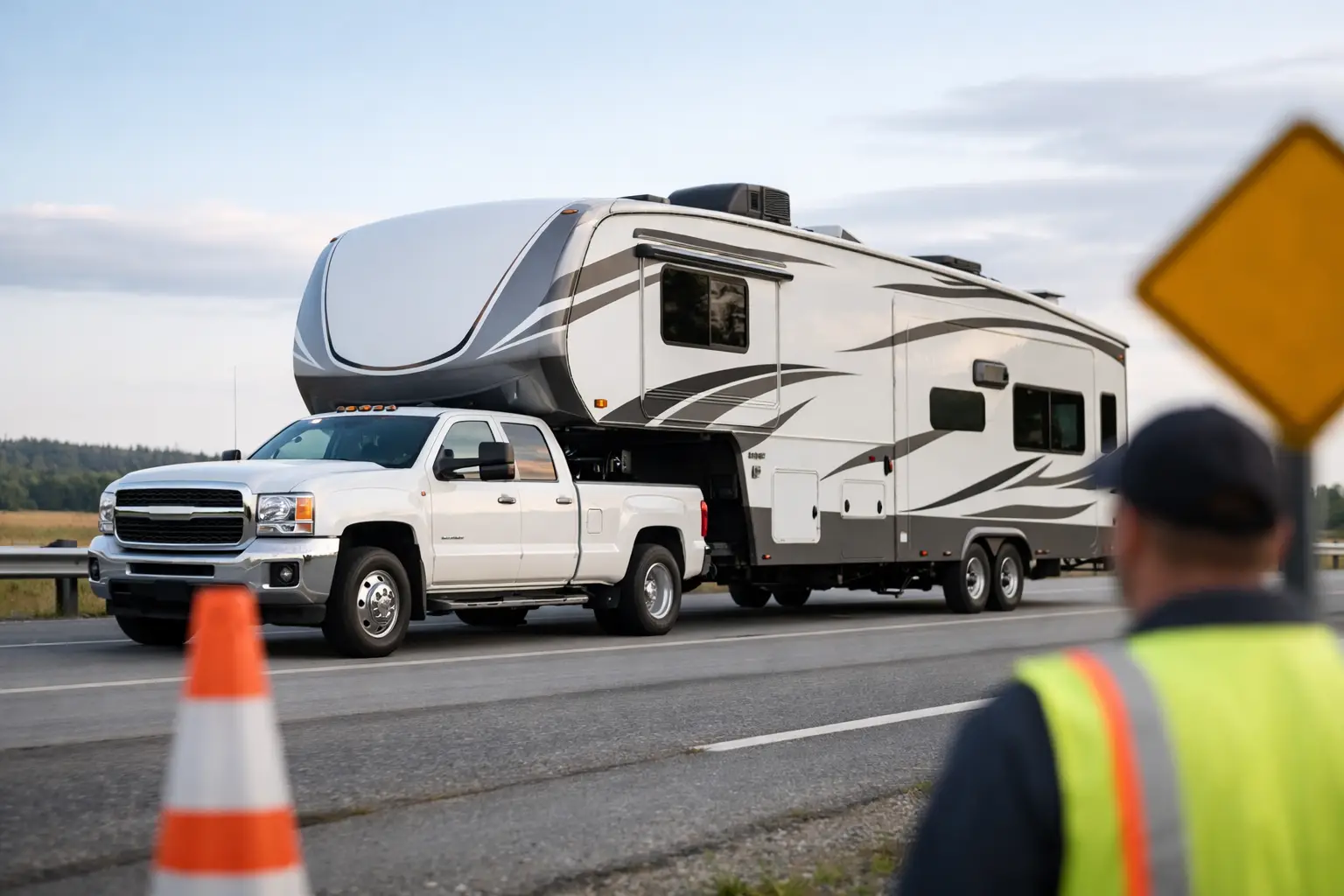
A fifth wheel can look ready to roll the moment it leaves the dealer or seasonal site. Legally moving it is a different matter. Knowing how to move fifth wheel legally means checking more than the hitch connection – the truck, driver, trailer paperwork, insurance, dimensions, and route all need to line up before you pull onto the road.
For some owners, that means preparing their own properly equipped setup. For others, especially when the move is long-distance, involves mountain routes, ferry schedules, or a new unit they have never towed before, it means hiring a properly licensed transport operator. Either way, the legal details should be handled before move day, not at the roadside.
Start With the Truck and Fifth Wheel Ratings
The first legal and safety question is whether the pickup is rated to handle the fifth wheel. A truck’s advertised maximum tow rating is not the only number that matters. You also need to account for the trailer’s actual loaded weight, pin weight, payload capacity, gross combined weight rating, axle ratings, and hitch rating.
The loaded weight is the number that counts. Water, propane, batteries, food, tools, personal gear, and upgrades can add far more weight than owners expect. A fifth wheel that appears to fit within a truck’s published rating may exceed payload limits once its pin weight is placed in the bed.
Check the truck’s door-jamb payload label and the manufacturer’s towing information, then compare those figures with the fifth wheel’s certification label and realistic loaded weight. Do not assume a heavy-duty pickup is automatically adequate. Different cab configurations, engines, bed lengths, and factory options can change payload substantially.
The hitch must be designed for fifth wheel use, correctly mounted, and rated above the loaded pin weight. The trailer should sit level when connected, with adequate clearance between the fifth wheel overhang and the truck bed rails. A too-high or poorly adjusted connection affects handling, braking, tire wear, and clearance on uneven approaches.
Licensing and Weight Rules Depend on Where You Travel
There is no single answer to licensing requirements because rules vary by province, state, license class, trailer weight, and combined weight. The right license for a fifth wheel move may depend on the actual weight of the combination, not just the trailer’s length or the type of pickup used.
Before departure, confirm the requirements in your home jurisdiction and every jurisdiction on the route. This matters even more on interprovincial moves. British Columbia and Alberta owners should verify current rules directly with the applicable licensing authority, particularly if the combination approaches higher weight thresholds or will be operated commercially.
If you are being paid to move a fifth wheel, or you are moving units as part of a business, commercial requirements can apply differently than they do for a private owner moving their own RV. Commercial registration, logbook rules, inspections, safety requirements, and driver qualification standards may also come into play. Do not rely on a neighbor’s setup or an old online forum post as proof that your move is compliant.
A professional hauler should be able to explain what license class and operating authority apply to their work. That is not paperwork for paperwork’s sake. It is part of making sure the person handling your RV is qualified for the job.
Registration, Insurance, and Documents to Carry
A fifth wheel needs current registration and valid license plates before it is moved on public roads. If you have just purchased the unit, make sure you understand how temporary permits, dealer documents, and registration transfer work in the jurisdiction where the trailer is picked up and where it will be registered.
Insurance needs the same level of attention. The policy should cover the fifth wheel while it is being transported, and the coverage should match the real value of the unit and its contents. Ask your insurer whether there are restrictions related to a hired transporter, cross-border travel, storage, or a new purchase awaiting registration.
When hiring a company, ask for proof of commercial liability and cargo coverage. Your own RV policy may not fully cover damage that occurs while a third party is moving the unit, and a contractor’s insurance should not be treated as an assumption. Confirm what is covered, what deductible may apply, and how a claim would be handled.
Keep the registration, insurance information, bill of sale or purchase documents when applicable, and any temporary permits accessible during the move. If the fifth wheel is financed, it is also smart to confirm whether the lender has any insurance or transport conditions.
Check Size, Weight, and Route Restrictions Before You Leave
A fifth wheel can be legal at the hitch and still be a problem on the route. Height is often the issue that creates the most expensive mistakes. Measure the actual overall height of the loaded trailer from the ground to its highest fixed point after it is connected to the truck. Do not rely solely on a brochure measurement.
Air conditioners, satellite equipment, raised suspension, tire changes, and an uneven connection can all change the real number. Record the height in the cab and plan for clearance below that figure, not right at it.
Length, width, axle weight, bridge restrictions, seasonal road restrictions, and local access rules can affect the route as well. A campground lane, residential street, service center entrance, or storage compound can be harder than the highway portion. Tight turns, low branches, soft shoulders, steep grades, and limited turnaround space should be considered in advance.
In western Canada, ferry travel adds another layer of planning. Ferry operators may require reservations, specific check-in times, and accurate overall length information. A missed sailing can delay the entire delivery, particularly during busy seasonal periods. Confirm the fifth wheel’s length, truck length, and any special loading instructions before booking.
Prepare the Fifth Wheel for a Road Move
A proper pre-trip inspection protects both legality and the RV itself. Start with the tires. Check tire age, pressure, condition, and load rating, including the spare. RV tires can look fine while being aged out, underinflated, or damaged by long periods in storage.
Test all exterior lights, brake lights, turn signals, and electric trailer brakes. Confirm the breakaway system is functional and its battery is charged. Safety chains should be used as required for the setup and jurisdiction, and the emergency breakaway cable must be attached correctly without dragging or binding during turns.
Secure every exterior compartment, entry door, slide-out, awning, roof vent, and loose accessory. Retract stabilizers and steps. Inside, latch cabinets, secure heavy items low to the floor, and avoid traveling with loose gear that can shift. If temperatures may drop, winterize the unit as needed before departure rather than after a plumbing line freezes on the road.
Before leaving, walk around the entire combination with a checklist. Look for low-hanging cables, open compartments, tire clearance issues, and anything that could contact the truck during a tight turn. After the first few miles, stop in a safe location and inspect the hitch, tires, lights, and load again.
When Hiring a Professional Is the Legal, Practical Choice
Many owners can legally move their own fifth wheel if they have the right equipment, license, insurance, and experience. But legal does not always mean practical. A new buyer may not own a suitable pickup. A seasonal move may not justify the cost of maintaining one. A long route may involve grades, traffic, fuel stops, ferry coordination, and delivery sites with little room for error.
A specialized RV transport provider can handle point-to-point delivery from a dealership, home, storage yard, service center, or seasonal site while you travel separately in your own vehicle. For owners moving a fifth wheel within British Columbia or Alberta, this can remove the stress of arranging a large pickup for a one-time move and help ensure the transport is handled by someone familiar with RV-specific loading, clearances, and routing.
Ask direct questions before booking: Is the operator properly licensed? What insurance applies? Is the trailer’s length and estimated loaded weight within their capability? Are ferry arrangements included if needed? What condition must the RV be in at pickup, and what happens if weather or road conditions change the schedule?
Give the Move the Same Attention as the RV Purchase
A fifth wheel is a major purchase, and moving it safely starts with treating transport as more than a drive from point A to point B. Get the weights right, verify the legal requirements for the route, inspect the equipment, and use a qualified professional when the job is beyond your comfort level. That preparation lets the first trip to your campsite begin as it should – with the RV arriving safely and ready to enjoy.
Comments are closed