

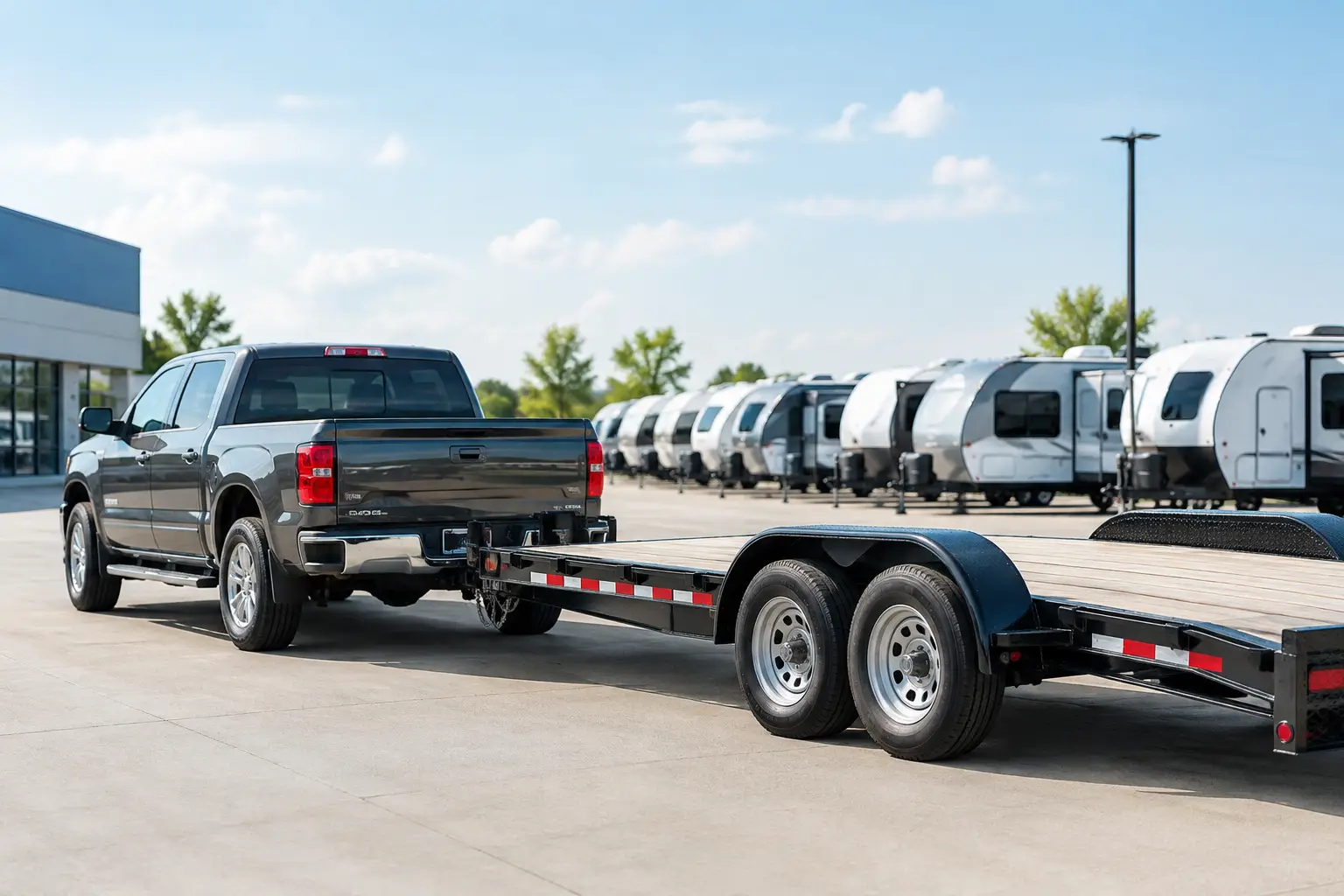
A new trailer can be ready at the dealership while the hard part is still sitting in the parking lot: getting it safely to your driveway, storage yard, seasonal site, or service destination. This guide to dealership trailer pickup logistics covers the decisions that prevent last-minute delays, damage concerns, and an expensive scramble for the right tow setup.
For many owners, dealership pickup is not simply a matter of hooking up and leaving. A travel trailer or 5th wheel may be new to you, but it has real height, weight, turning-radius, and route requirements from the moment it leaves the lot. Professional transport lets you take delivery without buying a heavy-duty truck, changing travel plans, or learning those lessons on a busy highway.
Start With the Trailer Details, Not the Pickup Date
Before scheduling transport, get the dealership to confirm the exact unit information. “It’s a 30-footer” is useful, but it is not enough for planning. The transporter needs the full exterior length, dry weight, estimated loaded weight, overall height, hitch type, and axle configuration. A 5th wheel requires a compatible truck and hitch arrangement, while a travel trailer requires the right ball, coupler, weight-distribution setup when applicable, and brake controller.
Ask whether the trailer has factory-installed accessories that affect clearance or handling. Roof air conditioners, solar panels, rear racks, ladders, slide toppers, and spare tire carriers can change the real-world dimensions. If the unit has multiple slides, confirm they will be fully retracted and secured before pickup.
Dealerships should also identify any work still outstanding. A trailer that is “almost ready” can mean it is waiting on a pre-delivery inspection, accessory installation, propane certification, battery installation, or warranty repair. Booking a pickup before that work is complete can leave a driver waiting or require a second trip. The best schedule starts after the dealer confirms, in writing if possible, that the unit is released for transport.
Confirm Who Handles Paperwork and Insurance
Paperwork should be settled before the driver arrives. Depending on the purchase arrangement, the dealer may need proof of insurance, signed sale documents, registration details, or written authorization allowing a third party to collect the trailer. Do not assume a spouse, friend, or transport provider can take possession without being listed or authorized.
Confirm where the bill of sale, ownership documents, keys, manuals, and warranty package will be kept during transport. Many owners prefer important documents to remain with the dealer for direct pickup or secure courier delivery rather than traveling inside the trailer.
Insurance deserves a direct conversation. Your policy may cover the RV, but coverage terms and responsibilities can vary while it is in professional transport. A reputable RV transport provider should carry appropriate licensing and insurance for the work, and should be able to explain what is covered during the move. This is not paperwork for paperwork’s sake. It is how everyone knows who is responsible if a road incident, loading issue, or unexpected delay occurs.
Prepare the Trailer for Road Travel
The dealership’s pre-delivery inspection is not the same as transport preparation. Before departure, the trailer needs a practical road-ready check. Exterior storage doors should be latched, windows shut, roof vents closed, steps retracted, stabilizers raised, and loose accessories secured. The awning must be fully stowed and locked.
Inside the trailer, unsecured items can move surprisingly hard over uneven roads. If the dealer has installed cookware, furniture accessories, televisions, or promotional materials, ask what will remain inside for delivery. Cabinet doors, refrigerator doors, shower doors, and sliding interior panels need to be secured. Heavy items should not be left loose on counters or beds.
The driver should inspect the coupler or 5th wheel connection, safety chains where applicable, breakaway cable, lights, tires, and brakes before leaving. A careful walk-around also documents the trailer’s condition at pickup. Photos of each side, the front cap, rear wall, wheels, and any existing marks are sensible protection for both the owner and the carrier.
Propane, batteries, and water add weight
Decide with the dealership whether propane cylinders and batteries will be installed for the move. They are common parts of a delivery-ready RV, but they add weight and need to be properly secured. Freshwater, gray, and black tanks should generally be empty unless there is a specific reason otherwise. Carrying water adds substantial weight, affects handling, and provides no benefit on a standard dealership delivery.
Plan the Route Around the Trailer, Not a GPS Shortcut
A route that works for a family SUV may not work for a trailer near 44 feet long. Low bridges, narrow fuel stations, sharp urban turns, construction zones, steep grades, and restricted park roads all matter. Professional RV transport is as much about route judgment as it is about having the right truck.
Give the transport provider both the dealership address and the final destination details early. Include the site number, gate codes, property contact, preferred arrival window, and any known restrictions. If the destination is a seasonal campground, ask the campground directly about arrival rules, road conditions, tree clearance, and whether the site can accommodate a long backing maneuver.
Some locations are straightforward only during certain hours. Busy campground check-in periods, narrow resort roads, city traffic, and limited storage-yard access can turn a simple delivery into a slow job. It may be better to schedule an early weekday arrival than force a large trailer through a crowded Friday afternoon.
For Vancouver Island deliveries, ferry reservations and sailing times need to be built into the plan. Trailer length, vehicle combination length, terminal arrival requirements, and seasonal demand can affect availability and cost. Ferry coordination is not an add-on to figure out later. It is part of the route.
Make Sure the Destination Is Actually Deliverable
The final few hundred feet are often harder than the highway miles. A rural driveway may have soft shoulders, low branches, tight gates, or an uphill turn that makes backing difficult. A storage compound may require a code, proof of insurance, or a manager to open a restricted area. A campground site may look open on a map but have trees or parked vehicles limiting the approach.
Send clear photos or videos of the entrance, driveway, and site when access is questionable. A short video taken from the road to the intended parking spot can reveal obstacles that an address never will. Be honest about slopes, soft ground, recent rain, construction materials, and vehicles that cannot be moved.
There is a trade-off here. Delivering directly onto a tight site is convenient, but it can take more time and may not be safe under poor conditions. In some cases, a nearby open area, storage lot, or accessible pull-through location is the better handoff point. The right choice depends on clearance, ground conditions, and whether the trailer must be backed into position.
Set a Pickup Window, Not an Unrealistic Exact Minute
Road transport involves variables: dealership release timing, traffic, weather, construction, ferry schedules, and the time required to inspect and connect the trailer. A good provider will communicate clearly, but a realistic pickup and delivery window is more useful than demanding a minute-by-minute promise that cannot account for the road.
Provide a reliable phone number for both the dealership contact and the receiving contact. If you cannot be present, designate someone who can approve placement, open gates, and answer practical questions. That person should understand exactly where the trailer is meant to go and what they are authorized to decide.
What to Have Ready Before You Request a Quote
A transport quote is more accurate when it is based on real details rather than guesses. Have the dealership name and address, trailer make and model, length, hitch type, pickup readiness date, destination address, and any access concerns ready. Mention ferry travel, remote roads, seasonal site restrictions, or timing requirements from the start.
GoMax RV regularly handles dealership pickups and point-to-point RV delivery for travel trailers and 5th wheels across British Columbia and Alberta. The goal is simple: your trailer leaves the dealership properly connected, properly checked, and headed to a destination that has been planned for the equipment involved.
Before you finalize a pickup date, walk through the route and destination one more time from the driver’s perspective. That small bit of preparation is what turns delivery day from a stressful handoff into the first easy step of using your RV.
Comments are closed