

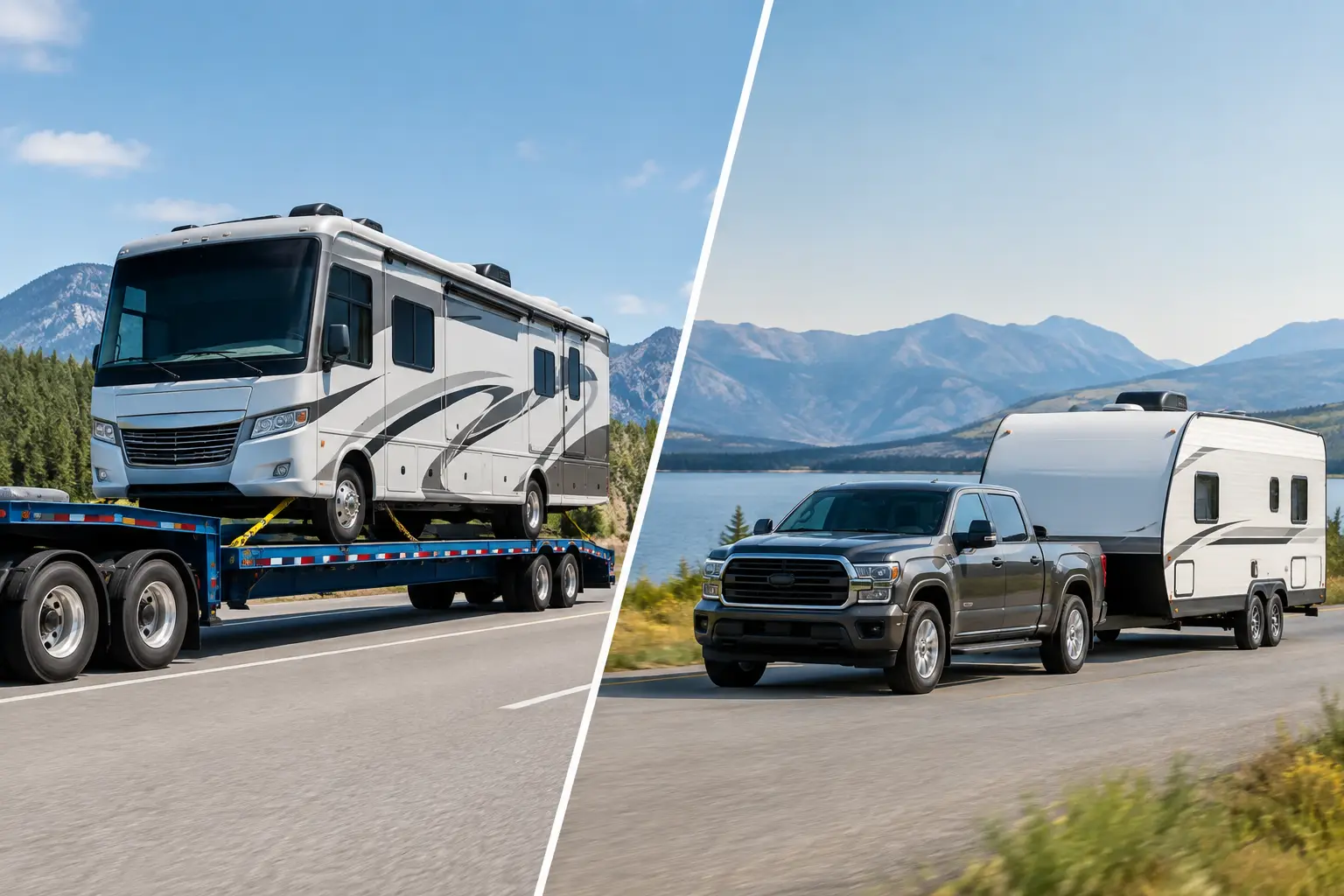
You have bought the trailer, booked the seasonal site, or received the call that service work is complete. Now comes the part many owners underestimate: getting a large travel trailer or fifth wheel safely from point A to point B. RV transport versus caravan towing is not simply a question of who is behind the wheel. It is a decision about equipment, time, risk, and how you want to use your RV.
For some owners, towing their own unit is a regular part of the RV lifestyle. For others, it is an expensive and stressful task that only comes up a few times a year. The right choice depends on the trip, the trailer, and your comfort level.
RV Transport Versus Caravan Towing: The Main Difference
Caravan towing means you handle the move yourself using your own properly equipped pickup and towing setup. You plan the route, load the trailer, manage fuel stops, deal with tight turns, and deliver the unit to its destination.
Professional RV transport means an experienced hauler moves the travel trailer or fifth wheel for you. You can drive separately in your personal vehicle, fly to your destination, or meet the RV when it arrives. The transport provider handles the hauling plan, towing equipment, road logistics, and delivery coordination.
Neither option is automatically better. A short move with a properly matched truck and an experienced owner is very different from a cross-province delivery, a ferry crossing to Vancouver Island, or a first-time fifth wheel pickup from a dealership.
When Towing Your Own RV Makes Sense
If you already own a capable truck, have the correct hitch equipment, and tow regularly, doing it yourself can be practical. It gives you complete control over the schedule and may make sense for frequent weekend trips where the trailer moves often.
Self-towing is usually easier when the route is familiar, the distance is manageable, and the destination has straightforward access. An owner who knows how their trailer tracks, brakes, turns, and behaves in wind has a real advantage over someone taking on a large unit for the first time.
It can also be worthwhile if your truck is used for other work or personal needs. In that case, the cost of owning the truck is not tied solely to moving the RV.
But the truck and hitch are only part of the equation. You also need to be comfortable with pre-trip checks, weight limits, tire condition, brake controller settings, backing, lane changes, mountain grades, and planning stops that have enough space for a long combination. A trailer that is easy to enjoy at the campsite still requires attention on the road.
The Real Cost of Owning the Equipment
Many RV owners compare a transport quote to the price of fuel for a single trip. That misses the larger cost picture.
Towing a travel trailer or fifth wheel safely often requires a heavy-duty pickup with sufficient towing and payload capacity, along with the right hitch, brake controller, mirrors, and maintenance schedule. Depending on the RV, there may be additional setup costs before the first trip even begins.
Then there are ongoing costs: insurance, registration, tires, fuel, service, depreciation, and repairs. Heavy towing puts real wear on brakes, transmissions, suspension components, and tires. A truck that is adequate for everyday driving may not be adequate for a loaded RV on a steep grade or a long highway run.
For owners who move their RV only at the beginning and end of the season, professional transport can be the more cost-efficient choice. You pay for the move you need instead of carrying the year-round cost of equipment built around occasional hauling.
When Professional RV Transport Is the Better Fit
Professional transport is often the sensible option when the move is long, complicated, or simply not something you want to manage. Common situations include dealer pickups, seasonal site deliveries, service appointments, storage moves, relocations, and return trips after a sale.
It is especially useful for new RV owners. Buying a fifth wheel does not instantly make someone comfortable with hitching, backing, navigating fuel stations, and handling crosswinds. Having a professional deliver the unit lets you start enjoying the RV without making the pickup day your first major towing test.
Professional hauling can also remove a scheduling problem. You may need to be at work, traveling with family, or preparing a site while the RV needs to move. Rather than spending a day or several days on the road, you can arrange point-to-point delivery and focus on the parts of RV ownership you actually enjoy.
For routes involving ferries, mountain passes, busy metro areas, or tight destination access, experience matters. A transport provider familiar with western Canadian routes can plan around ferry timing, road conditions, and practical arrival details rather than treating the trip like a simple highway drive.
Safety Is More Than Driving Skill
Good towing starts well before the trailer reaches the road. The unit needs to be properly hitched, its tires and lights checked, safety connections secured, and weight kept within the limits of the truck, hitch, and trailer.
On the road, safe operation means leaving more stopping distance, watching for wind, managing downhill speed, anticipating turns, and choosing places to stop before you need them. These are learned habits. They are not difficult to understand, but they do take experience to apply consistently when traffic, weather, grades, and tight spaces all add pressure.
A qualified RV hauler brings purpose-suited equipment and a working routine for these details. Licensing and insurance are equally important. Before handing over a valuable travel trailer or fifth wheel, ask what coverage applies, how the unit will be inspected, and how pickup and delivery are documented.
The cheapest option is not always the lowest-risk option. A small saving can disappear quickly if an inexperienced move leads to damage, delays, or a trip that becomes more stressful than expected.
Questions to Ask Before You Decide
Start with the trailer itself. How long is it, what does it weigh when loaded, and what hitch system does it require? A lightweight travel trailer and a full-size fifth wheel create very different demands.
Next, look honestly at the route. Is it a short run on familiar roads, or a long-distance delivery with mountain driving, ferry coordination, city traffic, or uncertain weather? The harder the route, the more valuable professional experience becomes.
Finally, consider how often you will move the RV. If it travels every other weekend, owning the setup and building your skills may fit your plans. If it sits at a seasonal lot for months and moves only for service or winter storage, arranging transport can be a cleaner solution.
Planning a Smooth RV Delivery
Whether you tow yourself or book transport, preparation prevents avoidable problems. Confirm the pickup and delivery address, gate access, site number, contact information, and any time restrictions. Make sure the destination has room to maneuver and that low branches, narrow turns, or soft ground will not create trouble.
Remove or secure loose items inside the RV. Close windows and roof vents, lock exterior compartments, check tire condition, and make sure the trailer is ready to travel. If the unit is coming from a dealership or service center, confirm that all work is complete before the scheduled pickup.
When requesting a professional transport quote, provide the year, make, model, overall length, pickup location, destination, and preferred timing. Mention special access conditions, ferry requirements, or any concerns about the route. Clear details lead to a more accurate plan and fewer surprises on moving day.
Choose the Option That Lets You Enjoy the RV
There is no prize for taking on a difficult haul when it does not fit your equipment, schedule, or confidence level. Self-towing can be rewarding for experienced owners with the right setup. Professional RV transport can be the practical answer when you want the trailer moved safely without building your life around a heavy-duty pickup.
For a dealer delivery, a seasonal relocation, or a service move across British Columbia or Alberta, GoMax RV can help take the hauling task off your plate. The best move is the one that gets your RV where it needs to be, ready for the time you planned to spend there.
Comments are closed