

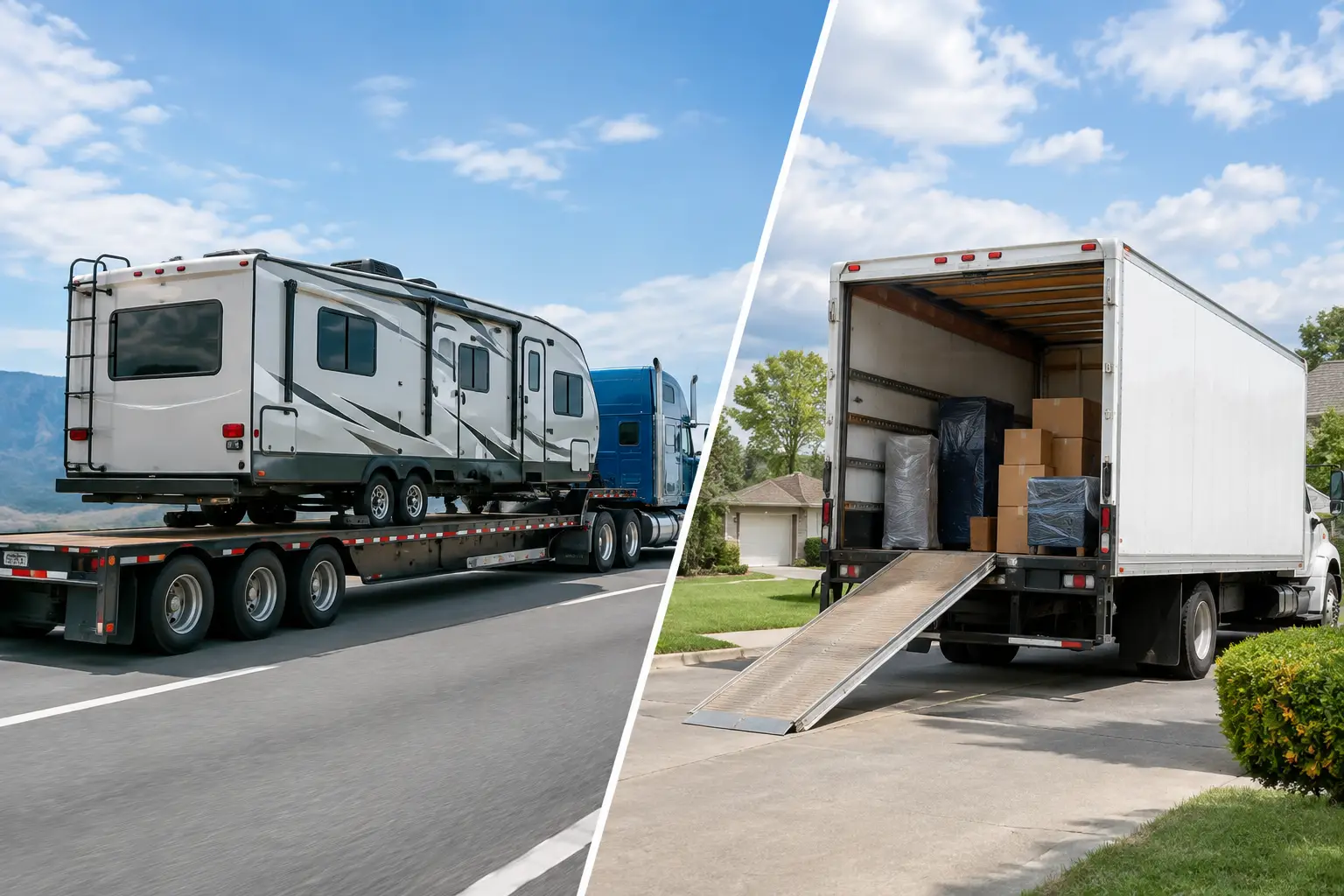
A travel trailer or fifth wheel is not household furniture on wheels. It has a hitch system, height and weight considerations, tires, brakes, slide-outs, and a destination that may be a tight seasonal site or a dealership lot. That is why the dedicated hauler versus moving company decision matters when you need an RV transported without towing it yourself.
A general moving company may be excellent at packing homes and relocating belongings. But moving a towable RV calls for a different kind of equipment, experience, and planning. The right choice depends on what is being moved, where it is going, and who is prepared to take responsibility for the road logistics.
Dedicated hauler versus moving company: the core difference
A moving company is built around household relocations. Its crews, trucks, scheduling, and insurance processes are generally designed for boxes, furniture, appliances, and sometimes large specialty items. If your RV move is part of a full household relocation, a mover may coordinate the overall plan. That does not automatically mean it is the right provider to transport the trailer itself.
A dedicated RV hauler focuses on moving towable RVs from one point to another. That can include dealer pickups, home deliveries, storage moves, service appointments, seasonal site relocations, and longer interprovincial routes. The work starts with the unit itself: its length, hitch type, condition, route, delivery access, and any ferry or timing requirements.
That specialization changes the conversation. Instead of asking how many rooms are in your house, a dedicated hauler asks practical questions: Is it a travel trailer or fifth wheel? What is the overall length? Is the hitch accessible? Are the batteries charged, tires serviceable, and slide-outs secured? Can the destination accommodate the unit?
Why RV-specific experience is worth paying for
The biggest difference is not simply having a truck that can pull a trailer. It is knowing how to prepare, inspect, connect, route, and deliver a towable RV safely.
A professional hauler understands that a fifth wheel and a bumper-pull trailer require different connections and different checks before departure. They know that the published length of an RV is only one part of route planning. Overall height, fuel stops, grades, construction zones, turnaround space, and the final approach to a campground or storage compound can all affect the move.
This is especially relevant when the RV is new to you. A dealer delivery may sound simple until you realize you would need a capable tow vehicle, the proper hitch setup, experience with trailer handling, and time to make the trip. Hiring a dedicated hauler lets you meet the RV at your home, storage location, or campsite while you travel separately in your own personal vehicle.
For owners moving between British Columbia and Alberta, route familiarity can also make a real difference. Mountain grades, changing weather, ferry schedules, and remote delivery locations require planning beyond a standard moving-day route. A hauler that regularly works those roads knows what questions to ask before the unit leaves.
Equipment and fit matter more than a big truck
A large truck alone does not make an RV transport provider a good fit. The tow vehicle must be matched to the trailer’s size and configuration, and the driver needs the proper equipment for the hitch system. The unit should also be checked for basics that can cause trouble on the road, including tire condition, lights, brakes, breakaway system, propane shutoff, and secured exterior items.
A dedicated hauler is more likely to make these checks part of the job because the trailer is the job. A general mover may subcontract the transport portion or treat it as an add-on. That can work in some cases, but you should be clear about who is actually hauling the RV, what their experience is, and who is accountable if plans change.
There is no need to assume every moving company is unqualified. Some have established specialty partners or teams with real RV transport experience. The key is verifying that the person assigned to your unit is equipped and insured specifically for the work, not simply available on moving day.
Insurance and licensing should be clear before pickup
Your RV is a major asset, and vague answers about coverage are a warning sign. Before booking any transport provider, ask for a clear explanation of licensing, commercial insurance, and what coverage applies while the unit is in transit.
Do not rely on a general statement that the company is insured. Ask what type of coverage applies to the RV, whether there are exclusions, and whether your own RV policy needs to be notified. If the move involves a dealer, lender, storage facility, or campground, confirm whether they have their own requirements for access, proof of insurance, or delivery appointments.
A dedicated hauler should be comfortable discussing these details in plain language. The goal is not paperwork for its own sake. It is making sure there are no surprises after the RV has left your possession.
When a moving company may still make sense
There are situations where a moving company can be useful. If you are relocating an entire household and need one coordinator for furniture, household goods, storage, and scheduling, a mover may simplify the larger project. In that case, the best arrangement may be a moving company handling your home contents while a dedicated RV hauler handles the trailer.
That split approach is often cleaner than asking one provider to do work outside its normal specialty. It also lets each company plan around the right equipment, timing, and insurance requirements.
A moving company may also be a reasonable option if it can show that it uses an experienced, properly licensed RV transport division or a named specialist partner. Get the details in writing. You should know who will arrive at pickup, what equipment they will use, and who to contact during the move.
The delivery point can make or break the job
Many owners focus on the highway portion of an RV move, but the final mile is often where the real planning happens. A campground site may have narrow roads, low branches, limited turning room, soft ground, or strict arrival hours. A storage facility may require gate codes and proof of authorization. A service center may only accept deliveries during certain windows.
Provide the hauler with the full destination information before booking. Include the site number, contact name, gate instructions, road conditions, and any concerns about access. Photos or a map pin can help identify tight turns or difficult approaches. If a campground requires an escort or has rules about delivery times, arrange that in advance.
Ferry travel deserves the same level of preparation. RV transport to Vancouver Island involves schedules, reservations, loading requirements, and enough time to account for delays. A provider experienced with ferry-inclusive moves can build those details into the quote and the route rather than treating them as a last-minute complication.
Questions that lead to a better quote
A useful quote is based on real job details, not a guess from one city to another. Be ready to share the RV make and model, trailer type, overall length, pickup and delivery locations, preferred dates, and the condition of the unit. Mention if the RV is at a dealer, in storage, on a seasonal lot, or awaiting service.
It also helps to state whether the unit is ready to move. Personal belongings should be secured, loose items removed from the exterior, slide-outs retracted, and access to the hitch kept clear. If the trailer has known mechanical issues, say so early. A professional can plan for the situation, but only if they know about it.
GoMax RV handles travel trailers and fifth wheels up to 44 feet, with transport planned around the actual unit and route rather than a one-size-fits-all moving package. That is the practical advantage of using a service built for towable RVs.
Choose the provider built for the load
If your main need is moving household goods, start with a moving company. If your main need is getting a travel trailer or fifth wheel safely from point A to point B, a dedicated RV hauler is usually the more direct fit.
The best move is the one that removes uncertainty before the pickup date. Share accurate RV details, confirm insurance and access requirements, and book early when seasonal demand or ferry schedules are involved. Then you can spend your time planning where you will use the RV, not worrying about how you will get it there.
Comments are closed