

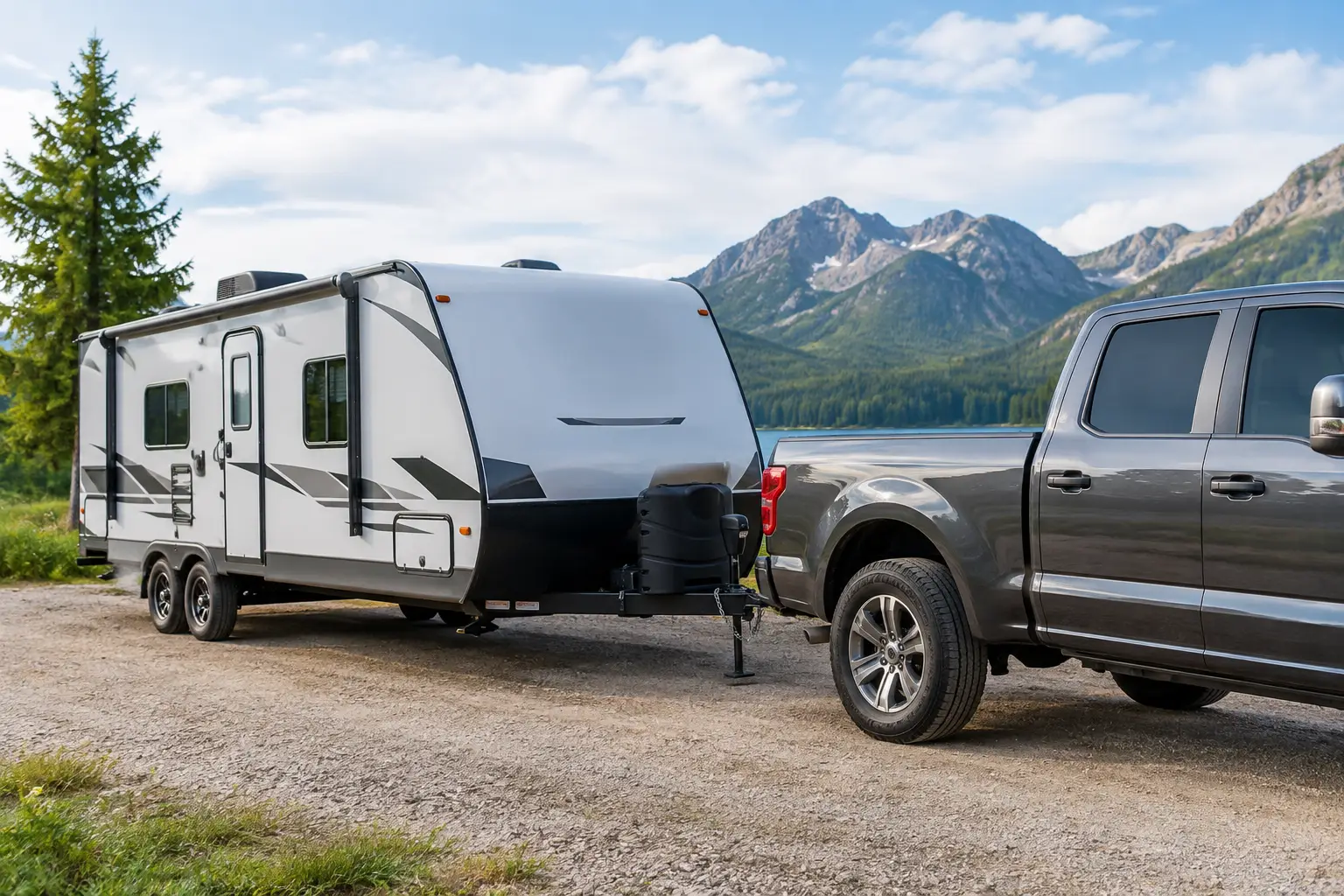
A travel trailer can look ready for the road while already being too heavy for the truck, hitch, tires, or axle beneath it. That is where expensive breakdowns, unstable handling, and stressful roadside stops begin. This guide to trailer weight limits breaks down the numbers RV owners need to understand before moving a trailer to a campground, service center, storage site, or new seasonal lot.
Why trailer weight limits are more than a number on a brochure
Weight ratings are not suggestions, and the published dry weight of an RV is rarely the weight you will be moving. Water, propane, batteries, dishes, tools, outdoor furniture, bikes, food, and personal gear add up quickly. A trailer that appears comfortably within a truck’s published towing capacity can still exceed a more limiting rating, such as payload, hitch capacity, or an axle rating.
The real question is not simply, Can this truck pull the trailer? It is whether the complete setup can stop, steer, remain stable in crosswinds, climb grades, and stay within the ratings assigned to every major component.
That matters on Western Canadian routes in particular. Mountain grades, long distances between stops, changing weather, ferry schedules, and tight campground access can turn a marginal setup into a difficult day. Proper weight planning gives you a safety margin instead of asking every part of the setup to operate at its limit.
A guide to trailer weight limits: the ratings to know
The certification label on the trailer is the starting point. It is typically found near the front of the unit or inside a storage compartment. Your truck’s driver-side door label and owner’s manual provide the other half of the picture. Do not rely on a sales listing, online forum, or another owner’s combination. Ratings can vary widely between model years and trim packages.
GVWR: the trailer’s maximum loaded weight
Gross Vehicle Weight Rating, or GVWR, is the maximum allowable weight of the fully loaded trailer. It includes the trailer itself, installed equipment, cargo, water, propane, batteries, and the portion of the weight carried by the hitch or fifth-wheel pin.
For example, a travel trailer with a 9,500-pound GVWR must not weigh more than 9,500 pounds when it is ready to travel. A trailer’s dry or unloaded weight may be much lower, but dry weight is not a safe loading target. It usually does not reflect dealer-installed options, full propane cylinders, batteries, or your camping gear.
GAWR: what each axle can carry
Gross Axle Weight Rating, or GAWR, is the maximum weight allowed on a particular axle. A trailer can be under its overall GVWR and still overload one axle if cargo is loaded poorly.
Heavy items stored at the rear can reduce hitch weight and contribute to sway. Too much weight forward can overload the hitch, pin, or rear axle of the truck. Load dense items low, secure them properly, and distribute them with the trailer’s axle ratings in mind.
Cargo carrying capacity: your real room for gear
Cargo Carrying Capacity, often shown as CCC, tells you how much weight can be added to the RV beyond its unloaded condition. This figure is useful, but read the label closely. Depending on the manufacturer, the stated unloaded weight may include some factory-installed equipment but not every dealer option or accessory.
Water is one of the biggest surprises. Fresh water weighs about 8.3 pounds per gallon. A 50-gallon tank adds more than 400 pounds before you load a cooler or fill a cabinet. If your route has reliable water available at the destination, traveling with a partially filled or empty fresh tank may make sense. If you are headed to a site without hookups, that trade-off changes.
Hitch weight and pin weight: weight that lands on the truck
Travel trailers transfer part of their weight through the hitch. Fifth wheels transfer weight through the pin over the truck bed. That transferred weight counts against the truck’s payload rating along with passengers, gear in the cab or bed, and hitch equipment.
A common travel-trailer target is roughly 10 to 15 percent of loaded trailer weight on the hitch. Fifth-wheel pin weight is often closer to 15 to 25 percent, depending on the floor plan and loading. These are planning ranges, not substitutes for a scale ticket.
This is why a truck may have enough advertised pulling capacity but not enough payload. A 12,000-pound fifth wheel with a 20 percent pin weight can place about 2,400 pounds on the truck before people, a hitch assembly, or cargo are added. That is a serious number, especially for lighter-duty pickups.
Tow rating, payload, and combined weight
Your truck’s maximum trailer rating is only one limit. You also need to stay under its payload rating, rear axle rating, tire ratings, hitch receiver rating, and Gross Combined Weight Rating, or GCWR. GCWR is the maximum allowed weight of the loaded truck and loaded trailer together.
The lowest applicable rating controls the setup. If one component is rated lower than the rest, that is the number you respect. Upgrading an accessory does not automatically raise the manufacturer’s ratings for the truck, frame, axles, or tires.
How to get the numbers right
The most reliable way to assess a loaded RV is to use a certified public scale. Weigh the truck and trailer together, then obtain axle weights where possible. Compare the actual results against the labels for the trailer, truck, axles, tires, hitch, and combined rating.
Before the scale visit, load the RV as you normally would for a real trip. Include passengers, fuel, water, propane, batteries, food, camping supplies, bikes, and any items kept in exterior compartments. Weighing an empty trailer may feel reassuring, but it does not answer the question you need answered on departure day.
Keep the scale ticket with your RV records. If you change the trailer’s equipment, add a generator, carry more water, or alter your normal cargo, weigh again. Weight distribution is not a one-time calculation.
Equipment helps, but it does not erase an overload
A properly matched weight-distribution hitch can help transfer part of a travel trailer’s hitch load to the front axle and improve control. Sway-control equipment can also be useful when correctly set up. For a fifth wheel, a properly rated hitch and correct placement in the bed are essential.
But these tools do not create payload or increase axle ratings. They are part of a correctly rated setup, not a fix for one that is overloaded. The same applies to suspension add-ons. They may improve ride height or handling, but the rating on the door label remains the rating that matters.
Tires deserve the same attention. Check the load rating, inflation requirement, age, condition, and speed rating for both the trailer and truck. Underinflated tires build heat, and overloaded tires have very little margin when pavement temperatures rise or road surfaces deteriorate.
When professional RV transport is the practical answer
There are times when the safest choice is not to assemble a marginal towing setup at all. New buyers may need a trailer delivered from a dealership. Seasonal owners may need to move an RV from storage to a site. Others need transport to a repair facility, winterization appointment, or a new home after relocating.
Professional RV transport is particularly useful when the trailer is large, the route includes unfamiliar grades or ferry coordination, or you do not own a properly rated truck. A qualified hauler should verify the RV’s dimensions and weight, match the job to suitable equipment, and carry the required licensing and insurance. For travel trailers and fifth wheels, details such as hitch type, tire condition, landing gear operation, battery charge, brakes, and access at both ends of the route should be confirmed before pickup.
GoMax RV handles these kinds of point-to-point moves for towable RV owners who want the trailer moved without taking on the equipment costs and road logistics themselves.
Prepare the RV before it moves
Weight ratings are only one part of a trouble-free transport. Remove loose items from counters and shelves, secure interior doors, latch exterior compartments, and confirm awnings are fully locked. Lower antennas, close roof vents, and make sure slide-outs are fully retracted. If the trailer has been sitting for a season, inspect the tires and brakes before scheduling the move.
Provide accurate pickup and delivery information, including gate codes, site numbers, low branches, narrow roads, soft ground, and any campground restrictions. A trailer that fits on the highway may still need careful planning at the destination.
The best weight plan is the one based on the RV as it will actually travel, not the brochure figure that helped sell it. Get the labels, load realistically, use a scale when needed, and leave room for the road conditions you cannot control.
Comments are closed